Rejoice In The Nostalgia – PSW #940
In the security news this week:
- Cursor opens your repo, the repo opens you
- If you want the good model I'm going to need to see your ID
- Flock's a Flocking mess
- Defender was supposed to be the chosen one
- Side stepping Secure boot - twice
- SonicWall: a LAMP stack in a fancy case
- Macs don't get viruses, part infinity
- Flipper One, but why not Nix?
- NetScaler is back in the room
- Borrowing phone's good reputation
- USB and how to make Windows download stuff
- A KVM with the expensive letters removed
- Five steps to stop the webcam creeps
- PlexTrac acquired
- NIST asks the internet to fix the NVD
- Poland's health software has a very bad week
- If Apple pings you about spyware, believe it
- A macOS stealer that drives your browser for you
- T-Mobile's incident response tool of choice may suprise you, or not...
Gallery Images


Let’s be honest, most threat intel is just noise. You’ve got feeds everywhere, but turning that into detections or hunts is still way harder than it should be.
So how do you actually operationalize it?
At the Threat Intelligence Virtual Cybersecurity Summit on August 26th, learn how to integrate intel into your workflows and make it useful for real-world detection and response.
Security Weekly listeners can register for free at https://securityweekly.com/threatintel using the promo code: CSS26-SW
Unlock the full InfoSec World experience with the All Access Pass, featuring premium workshops, exclusive content, VIP experiences, and expanded opportunities to connect with cybersecurity leaders across industries. Join us in Orlando, October 12–14. Listeners save 30% on their pass with code ISW26-SWSAVINGS at securityweekly.com/infosecworld2026.
Paul Asadoorian
- Cursor 0-Day Lets Attackers Execute Malicious Code by Opening a Repository
The bug itself is a museum piece. Untrusted search path, plant a binary with the right name and wait. We have been writing that finding up since the nineties[1], and now it's back because an AI IDE shells out to git the moment you open a folder. The AI tooling space is speedrunning every bug class we already solved, and this one didn't even need a novel twist. Attackers love easy, and this attack is easy, showing how attackers live off the land. Do I need a shiny new RCE to get root? No, just need a watering hole repo with some malicious software and wait for the user, or better yet the AI, to come find it, download it, and execute it on your system.
[1] Example: Put the current directory in root's PATH, drop a trojan ls or su in a world-writable directory, wait for an admin to cd there. "Never put dot in root's PATH" is in every Unix security text of the era, from like the 1980s...
- Researchers say OpenAI revoked their access to limited cyber program
Summary: Five security researchers told TechCrunch their access to OpenAI's Trusted Access for Cyber program was suddenly revoked, with ChatGPT's Cyber page saying their identity couldn't be verified or their account was ineligible. OpenAI says it was a technical issue affecting a limited number of users and is asking them to re-verify. Notably, every researcher TechCrunch spoke to lives outside the US and Europe. TAC is the vetted tier (Daybreak Blue for defenders, Daybreak Red for offensive work) that relaxes guardrails for approved researchers, and Anthropic runs a similar program (I love how Claude added that little fact for us LOL).
Paul's take: AI told me this: "Take the glitch explanation at face value; it's probably true, and they're fixing it." We joke about Skynet, but every day I am more anxious about the AI threat. Here's the messed-up part: You now submit government ID to a private company to use a model for vulnerability research, and the people who lost that privilege overnight all happened to live outside the US and Europe. Even if that's a coincidence (it likely isn't), it's a preview of who ends up on the wrong side of the velvet rope. This is the same club-membership problem I keep complaining about: the capable tooling goes to the vetted, and attackers running their own models in a basement somewhere aren't filling out an application for Daybreak Red, but happily bypassing guardrails.
- Flock Has a Powerful New AI Tool for Police. We Got Its Code
- Operation CameraSwarm: Over 14,000 Dahua cameras compromised across Ukraine and Russia
Why do threat actors leave all of their tools and data on an open HTTP server with directory browsing enabled? It's like the 4th time I've seen this recently. By all means keep doing it, but also, opsec is apparently not cool anymore amongst criminals?
- Windows Defender Update for 0-day Vulnerability Breaks Virus Scans
"You were the Chosen One! It was said that you would destroy the Sith, not join them! Bring balance to the Force, not leave it in darkness!"
- Breaking secure boot without breaking the crypto
Summary: 0x434b published a long research note (57 minutes by the site's own count) making the case that mature secure boot failures almost never involve breaking the cryptography, because the signature math is usually the strongest part of the system. He sorts roughly twenty published, real-world bypasses into four buckets: did the check actually run and stop boot, did the signature cover the right bytes including metadata, was the signer the right authority for that product and version, and are those still the bytes that execute when control transfers. Cases span Qualcomm, Chromecast, Sonos, Nexus 6, NXP, MediaTek, MCUboot, U-Boot, ESP32 and AMD, and he closes each bucket by asking whether remote attestation would have caught it, which it mostly would not.
Paul's take: This is the article I want to hand to everybody who thinks secure boot is a checkbox. Nobody is factoring RSA. What keeps happening is that the verifier returns the mathematically correct answer and the surrounding code asks the wrong question, ignores the answer, or applies it to the wrong object.
You have to read some of these twice. And re-read the whole article to really consume everything because it covers so much ground.
On the Sonos and on the old Nexus 6, the kernel is genuinely signed and genuinely verified, and then an unsigned boot argument hands that kernel an attacker-controlled initramfs and your own /init runs as root. The kernel was signed. What the kernel was told to do was not. This is a fairly common theme in Secure Boot bypasses.
Also note this is a survey of other people's research, and he says so and credits them all. Most of these also need physical access or an existing foothold, so nobody should walk away thinking signed boot is pointless. But his four questions are a real review checklist, and the closing line is the best part: if your answer to any of them is "I assume so," that's exactly where you start reversing.
- Boot a custom Linux kernel on a rooted LG webOS TV via kexec
Summary: It is not a secure boot bypass and doesn't claim to be: LG's signed bootloader, ATF and OP-TEE are never touched. The jump happens from the stock startup.sh after LG's own signed kernel has already booted, entirely in RAM, so a power cycle puts you back to stock and it cannot brick the set. It's labeled work-in-progress honestly, because the custom kernel reaches userspace but the SoC watchdog resets the TV after 10 to 21 seconds.
Paul's take: Let's start with what kexec actually is, because it sounds scarier than it is. It's a syscall that loads a second kernel from inside the running one and jumps straight to it, skipping firmware, POST, all of it. Completely legitimate, and it's in every enterprise distro for good reason. The big one is kdump: when a box panics, you kexec into a tiny capture kernel that dumps the dead kernel's memory to disk, and it works only because skipping firmware means RAM never gets wiped. It's also how you reboot a large server without waiting minutes for the firmware to count its own DIMMs, and it's the basis for kexec-based bootloaders like Petitboot and LinuxBoot, where you use Linux itself as your bootloader so you get Linux's hardened drivers and network stack instead of whatever the vendor firmware shipped.
Now the question everybody's going to ask: does this mean you can swap out the kernel on any Secure Boot Linux box? No, and the reason is interesting. It used to be exactly that. The old
kexec_loadsyscall takes an in-memory image with zero integrity checking, so root with CAPSYSBOOT could stage arbitrary bytes and jump into ring 0, which is a clean end run around your entire signed boot chain. That is precisely why kernel lockdown exists, Matthew Garrett's work, merged upstream in 5.4. On a mainstream distro today, booting with Secure Boot on puts the kernel in lockdown, lockdown killskexec_loadoutright, and the newerkexec_file_loadtakes file descriptors and runs the kernel's own signature check. Only a validly signed kernel gets loaded. kdump still works fine because the capture kernel is signed. So on a properly configured modern box this is closed, and you needed root to start with anyway.Which is exactly what this TV is. It runs Linux 4.4.3, and lockdown didn't land until 5.4, so there is nothing behind the signature check at all. LG's secure boot verifies the chain up to the signed kernel and then stops caring, and once that kernel is up and you have root, kexec is right there. That's the actual lesson: verified boot is a statement about how you started, not about what you're running now, and if you don't lock down the runtime you've built a very expensive front door onto a house with no walls. Credit to the author for saying plainly that they sidestepped secure boot rather than broke it.
- Inside a Multi-Agent AI Framework Used to Compromise Government Entities in Asia
- From WSProxy to Root: INC ransomware and SonicWall SMA Exploit Chain
Back in the day, I put a Red Hat 5.2 Linux box on the Internet, and within a week it was hacked. I then built enterprise services using LAMP (Linux, Apache, MySQL, PHP). We hand-crafted the servers, services, and configuration. It too was hacked, like a lot. Then we learned to turn off default services, harden boxes, improve code quality, use ephemeral containers, and host services in the cloud, stripping away much of the attack surface.
Threat actors must be throwing parties themed around network edge devices, thanking them for bringing back unhardened Linux stacks that look just like the LAMP stacks from days of old, and rejoicing in the nostalgia. Except, it's not nostalgic any longer; it represents what is accessible to the Internet and at the edge of your enterprise network. (This was written entirely without the help of AI).
Sonicwall SMA's are just using a fancy LAMP stack, with a nice shiny case in something they call an "appliance".
- D-Link DWR-M961 Router Hit by 15 Command Injection and Buffer Overflow Vulnerabilities
- Vulnerability giving attackers full control of Macs is under active exploitation
- Microsoft Copilot reveals secret input that allowed it to be hacked
- Flipper OS – The operating system for Flipper One
Summary: Flipper's Pavel Zhovner laid out the design for Flipper OS, the software layer for the upcoming Flipper One, a dual-processor device where an MCU drives the screen and buttons while a separate CPU runs a Debian-based Linux. Instead of one OS you slowly turn into a junk drawer, a boot menu lets you pick between preconfigured profiles (router, radio lab, desktop, TV media box), each with its own root, kernel, and device tree, with every change you make landing on an overlay you can wipe to return to stock. They explicitly reject containers because they want full bare-metal access for things like patching Wi-Fi drivers and bit-banging GPIO; they want users to clone and share profiles with the community, and they say up front that atomic updates are still an unsolved problem with OSTree and Btrfs both on the table.
Paul's take: The core idea is right for the device. A box that's a router today and a radio lab tomorrow genuinely does need disposable system images with a reset button, and containers really don't help when you're modifying a device tree. What made me laugh is that the post spends several paragraphs on how nobody has solved this, throws a jab at NixOS on the way past, and then closes by saying they're evaluating OSTree and Btrfs snapshots. Boot environments have been a solved problem on illumos and FreeBSD for well over a decade, Silverblue has shipped OSTree for years, and "most Linux systems still don't let you roll back" in 2026 is a stretch. Taking the good ideas is fine, but the honest framing is that this is packaging, not invention.
The thing I actually want them to answer is the part the post skips entirely. They want a community marketplace where you download somebody else's OS image, including their kernel and their device tree, onto a device with full hardware access and a pile of radios attached. Not a word about signing, verification, or what happens when a popular "travel router" profile turns out to have malware baked into it. The same question hangs over atomic updates, which they openly admit they haven't figured out. Those two things are the whole ballgame for a device like this, and right now it's a nice design blog with the hard parts marked TODO.
- Be careful what you put in “anyone with the link” Google Docs
- I found a KVM guest-to-host heap corruption bug and someone else got there first
- You’re Back In The Room (Citrix NetScaler Pre-Auth RCE CVE-2026-8452(?))
Summary: A pre-auth heap overflow in NetScaler ADC and Gateway, reachable when the appliance is configured to use SAML as either a service provider or an identity provider. Deep tech summary: An oversized PrefixList attribute inside the SAML SignedInfo element overflows a fixed-size buffer during signature canonicalization, spilling into the header of the neighboring network buffer chunk, and because one of those clobbered fields is a data pointer a later memcpy trusts, it becomes a write-what-where. They chain that into a function pointer overwrite, shellcode on the heap, a PHP webshell, and root.
Paul's take: The bug itself is a fixed-size buffer stuffed with an attacker-controlled string, which is the sort of thing you'd catch in code review in about four seconds, but what got me is the environment it lands in. nsppe is non-PIE, there's no ASLR, the heap is executable, and the process runs as root and handles the entire network stack. In 2026, on the box that is the front door for remote access at a huge slice of the enterprise world. No info leak, no ROP chain, just overwrite a function pointer with a known heap address and jump to your shellcode. You couldn't get any further from "Secure By Design".
They had to diff 39,637 functions to figure out what Citrix actually fixed, because the advisory says "Memory Overflow" and doesn't tie CVEs to the researchers credited. That isn't a patch note; that's a riddle. Nobody is claiming in-the-wild exploitation yet, and the article doesn't either, but it's a pre-auth RCE on a NetScaler gateway, and we all know how that story usually ends. If you've got SAML configured on one, that's your reachability condition, so go get to 14.1-72.61 or 13.1-63.18.
- Bypassing Android Hardware Attestation from the Analyst’s Chair – Quarkslab’s blog
Summary: Quarkslab's Eric Le Guevel published a walkthrough of Android hardware key attestation end to end, then a bypass that never touches the secure hardware at all. The analyst keeps their rooted phone, hooks the attestation call with Frida, forwards the backend's challenge to a second clean unmodified phone, and splices that phone's genuine TEE or StrongBox chain back into the target app. Nothing is forged, every certificate is authentic and signed by real hardware up to a Google root, and the backend validates it because it has no way to tell which phone actually produced the evidence. The relay survives only because the backend never reads attestationApplicationId, the field naming the app that requested the key, and because it treats attestation as a one-shot gate at login. The backend, demo apps, and instrumentation are all published in a companion repo.
Paul's take: First, hardware attestation is good for things like DRM or anti-cheat, but I keep coming back to how it really doesn't stop attackers from living off the land and running ransomware attacks. Don't confuse security measures that tackle unauthorized users from ones that are interested in authorized users. Also, Interesting that attestation binds a key to a healthy device, but not to this device. That's the whole thing, and it makes this a relay attack, same shape as keyless car entry or NTLM relay, and the answer to a relay is always the same. Bind the proof to the thing you're actually talking to. What I like is that they didn't touch the crypto or the TEE at all. No leaked keybox, no side channel, no TrickyStore, just two phones and a Frida hook, and from the backend's chair the relayed bytes and the local bytes are identical. Then the fix turns out to be embarrassingly cheap: the certificate already carries the package name and signing cert digests of the app that asked for it, and the backend simply never bothers to look. One comparison, server side, no client change. We keep buying hardware roots of trust, TEE, StrongBox, secure elements, TPMs, and then wiring them into a backend that sees a valid signature and opens the door, which is how you turn a hardware guarantee into a formality. If you gate anything on attestation, read the app ID field, and make the client prove it still holds that key later in the session instead of trusting one handshake at login.
- UEFI Vulnerability Discovery with AI and LLMs
The UEFI bits weren't the most interesting here; to me, it was more about the LLMs and which ones performed better than others.
- Plug & Pwn: Weaponizing Windows PnP
Summary: Red team operators Alejandro Hernando and Borja Martinez released the full kit from their DEF CON 34 talk, "Weaponizing Windows PnP," showing that plugging in a USB device makes Windows fetch a signed vendor driver package from Windows Update and run its install code as NT AUTHORITYSYSTEM, with no admin rights and no logged-on user. They chain low-severity bugs across vendors: a Sierra Wireless named pipe with an Everyone ACL that lets any user change the machine's DNS, a Sony FeliCa co-installer that pulls its config over plaintext HTTP and mishandles backslashes in the filename, giving an arbitrary write into System32, and a Wacom service that spawns an interactive SYSTEM shell when it finds a hardcoded value in the registry. A second chain does it remotely with no hardware at all, forging USB descriptors over RDP USB redirection as a standard user, and the tooling and PoC videos are all published.
Paul's take: The framing is the whole story here, and the researchers get it right in their own FAQ: this isn't a zero-day; it's the feature working as designed, and some of the press coverage apparently couldn't sit with that. USB descriptors are just strings a device asserts about itself, so the attacker gets to pick which vendor's install code Windows downloads from Microsoft and runs as SYSTEM at the logon screen, with nobody signed in. The RDP variant is even better, because there the client tells the server what hardware exists and the server simply believes it, with no hardware anywhere in the attack. But the detail that should embarrass somebody is Atheros: CVE-2019-10617 is seven years old, and that signed package is still reachable and installable straight through Windows Update in 2026. We burn enormous energy worrying about attackers getting malicious drivers signed, and meanwhile the known-vulnerable signed ones nobody bothered to revoke sit in the catalog, waiting for a fake VID and PID to summon them. No Windows patch fixes this, and to their credit they say plainly that DisableCoInstallers did not stop the install in their test environment. Windows installing software you never asked for, but that's not only limited to Windows (E.g. pip, cargo, Go installers all do the same thing with dependencies).
- PicoTTY: A KVM Without the V (or the M) for My Homelab
Summary: A homelab build log for PicoTTY, an out-of-band console for machines that don't have a serial port. Each node is a Raspberry Pi Pico with a WIZnet Ethernet HAT that plugs into a target over USB and enumerates as a composite device, a CDC serial port and an HID keyboard at the same time, while its network side rides SPI so the USB port stays free for the target. A Pi Zero 2 W hub runs a single Python asyncio process with a web dashboard to drive the whole fleet, and the author's cost math is roughly ten times cheaper than one commercial IP-KVM per box because he threw out the video capture entirely.
Paul's take: Look at what he actually built: a permanent, network-reachable HID injector bolted to every machine in the rack. That's a Rubber Ducky fleet with a web dashboard, and I mean that as a compliment. He gets exactly why it works, HID is alive at power-on because BIOS and bootloaders speak it natively, while USB CDC serial is dead until the OS enumerates the device and something is listening on the other end. That's precisely why attackers like HID too, and it's why the fencing matters more than the firmware: isolated management VLAN, dashboard behind a tunnel, shared token on the first frame. He says outright that the node-to-hub link is unencrypted on purpose and that he vibe-coded a good chunk of it, which I'll take over a homelab post that pretends otherwise. My favorite part is that he tried the "proper" out-of-band tooling first and Intel AMT boot-looped his machine while AMD DASH did nothing at all. A Pico and an Ethernet HAT beat vPro. Nobody who has looked at AMT's history is going to be shocked by that.
Jeff Man
- Brinqa Acquires PlexTrac to Close CTEM Loop; Becomes Largest Standalone Unified Exposure Management Vendor
I know PlexTrac from back in the day when they sponsored the show. In fact, I just saw Dan at Hacker Summer Camp. Not sure what to think of this acquisition as i'm not familiar with Brinqa. Thoughts?
- NIST asks industry what to do about AI and vulnerabilities
Should we point them to countless shows where we've discussed this?
- NIST targets NVD modernization as AI transforms vulnerability discovery, risk assessment and remediation
Another take...
- Request for Information (RFI) on Modernizing the National Vulnerability Database in the Age of Artificial Intelligence
The actual RFI as published by NIST to the Federal Register.
- UT San Antonio delays start of fall semester after cyber breach
Pretty light on the details, but the article makes it sound like university IT and Security were on top of things immediately. But then, they did shut down pretty much the entire network including (apparently) VoIP.
- Data breach notices have already blown past last year’s total — and AI is playing a growing role
Interesting statistics and way to measure breaches. Bonus: You can listen to the article using an AI-generated voice!
- Investor suit says UnitedHealth ignored governance, cybersecurity gaps for years
Quite the laundry list of allegations. I can't help thinking though that all of this nefarious activity was really just "best practices" based on the industry as a whole.
- Researchers confirm breach claims by data-extortion group
Ah, a Microsoft problem with Power Page. Nothing to see here. Move along.
- 40,000 Impacted by SafePal Data Breach
“This incident did not involve your seed phrase, private keys, wallet password, or other wallet credentials, bank account information, payment card numbers, or government-issued identification numbers,”
...so they are only focused on the traditional data they have to protect. Didn't they read the 2026 Verizon DBIR???
- PLM Zero Day Flaw Exploited by Clop in Massive Data Breach
Russian hackers breach nearly 50 firms including Shell, GE and Philips, exploiting zero day vulnerability in popular product lifecycle management tool.
Now this is a PCI story. Sorta.
"This comes down to one core issue: concentration risk and underscoring the importance of vendor risk assessments, software intake reviews and threat modelling,”
Sure looks like more than one issue.
Larry Pesce
Lee Neely
- PBS station fears losing 50TB of data after being ghosted by cloud storage provider
Summary: In late July 2026, St. Louis Public Television station Nine PBS, also known as KETC Channel 9 (KETC) sued Iron Mountain Data Centers in an attempt to recover 50TB of data stored on equipment housed in one of Iron Mountain's data centers. KETC had contracted with a company called Open Source Storage for "hardware, software, and cloud storage services;" when KETC attempted to renew its contract with Open Source Storage in March of this year, the station discovered that the data storage company has ceased operations. Furthermore, KETC found they were unable to access their data despite a clause in the contract that allowed KETC 30 days following contract termination to retrieve data.
Lee's Take: This is a tricky but not unlikely backup scenario. Your data is stored with a third-party (OCC), housed in a fourth-party facility (Iron Mountain). You put a clause in the contract allowing for access to that data in the event something happens, but you still don't have access. This exact scenario is not likely but should be considered. Iron Mountain, or any other hosting provider, isn't going readily grant access to one of their customers' infrastructure/servers without a court order. This is as it should be. Your mission, should you decide to accept it, is to talk to third-parties who have your data, likely housed at a fourth-party, data center, cloud or otherwise, to find out what recourse you have in this situation.
- Investigation of banking hack leads to arrests in Europe, Brazil
Summary: German and Brazilian authorities said there were multiple arrests this week related to a late 2023 hack that drained an estimated €30 million ($34.7 million) from German bank accounts. Germany’s federal police agency, the BKA, said three suspects were picked up in Europe and charged with fraud, and Brazil’s federal police said four others were arrested on similar charges there as part of Operation Clone.
Lee's Take: Score one for BKA and ZIT cooperation, aka Operation Clone, to catch these guys. The courts also ordered seizure of their financial assets, vehicles, and real estate. In case you're wondering about the customers who were defrauded, the bank covered their losses. The hack, which only lasted four days, exploited a software vulnerability introduced by a faulty update in a payment and transaction-processing system. The flaw was subsequently corrected. Given the complexity of the efforts to launder the pilfered funds, it's pretty cool that authorities were able to trace the funds back to the criminals.
- Expanding Capabilities to Combat Transnational Cyber-Enabled Crime
Summary: Last week, the White House issued an Executive Memorandum outlining plans to allow private sector companies to participate in disrupting the activity of Transnational Criminal Organizations (TCOs). The program will be created, managed, and maintained by the National Coordination Center (NCC), and will be overseen by co-Executive Directors from the Department of Justice and the Department of Homeland Security. Participating private sector companies will be vetted and expected to abide by "strict operational procedures." By October 11, 2026, the Program Executive Directors, in coordination with the Homeland Security Council, are expected "to establish consensus operating procedures for the Program that ensure the Federal Government’s complete oversight and control of Participating Companies’ performance.
Lee's Take: Before jumping to, yes, we can attack back, make sure that you're aware of the needed contract, training, procedures and vetting required before you can do that. The good news is this also opens the door for partnerships with Federal, State, local, tribal and territorial agencies who will be identifying threats to participating companies. The hard part will be waiting for the procedures to see if you want to participate.
- Crypto wallet maker Trezor confirms 13,000 customers’ details exposed in logistics breach
Summary: Trezor, a Czechia-based cryptocurrency hardware wallet maker, has confirmed that a security breach at one of the company's logistics partners has exposed sensitive customer data. ShipMonk, a shipping provider, alerted Trezor to the incident on August 10, 2026; ShipMonk reportedly said the customer data were accessed via a vulnerability in Metabase. The compromised data include names, phone numbers, and email and physical addresses. Trezor reportedly said in a social media post that they are working on an "Anonymous Delivery" method for customers, which would allow them to make purchases without linking home addresses or identities.
Lee's Take: The shipping information is expected to be leveraged in an attempt to trick customers into providing access to their digital wallet or a backup thereof. Trezor's anonymous shipping option, where the device is sent, in unbranded packaging, to an alias at a shipping locker, not tied to the real account name or address, followed by separate communication with the PIN to open the locker, should serve to make captured shipping data almost without value. It will be interesting to see if any other online retailers implement a similar scheme.
- Poland probes MyDr healthcare software breach potentially affecting 19 million people
Summary: Polish authorities are investigating a cyberattack targeting healthcare software provider MyDr that may have exposed data belonging to nearly 19 million people and more than 12,000 medical facilities. MyDr, a privately-owned Polish company that supplies software to doctors, clinics and other healthcare providers, said on Friday that it had identified and removed the cause of the incident.
Lee's Take: The MyDr site has regular updates on the incident, including service status and information on what actions, if any, patients and doctors need to take. They are even monitoring the Dark Web for the pilfered information. Unfortunately, they are not disclosing the exact nature of the compromise other than the core issues being resolved. There are reports that the certificates needed to access MyDr's GitHub source code repository were alegedly compromised and they were able to download the source for the application and find information needed to access the AWS back end for the service, which is why MyDr is replacing all their authentication certificates.
- Max severity SAP Commerce Cloud flaw now targeted in attacks
Summary: A maximum-severity SAP Commerce Cloud remote code execution vulnerability patched three days ago is already being targeted in attacks, according to threat intelligence company Defused. Commerce Cloud (formerly known as SAP Hybris) is a cloud-based e-commerce platform used by online stores owned by high-profile global brands and large retailers. Tracked as CVE-2026-58231, this has a CVSS score of 10.0
Lee's Take: That timeline between a patch and successful exploit, presumably derived from reverse engineering the fix/update, is converging on zero. Beyond expeditious patch application, make sure that you're leveraging addtional protections, such as a WAF, segmentation, MFA and EDR to make vulnerable components harder to reach and (attempt to) exploit in the first place.
- If Apple sends you a push notification alerting you to a spyware attack, take it seriously
Summary: Apple users in 110 countries received a push notification stating, "Apple detected a mercenary spyware attack targeted at your iPhone. There are actions you can take now to protect your data and device." Apple published a support article the same day to explain the notifications and to emphasize the complexity and focus of mercenary spyware attacks, which expend considerable resources to target a small number of individuals.
Lee's Take: The advice given applies for all your mobile fleet, keep them updated, require passcodes, Touch ID or Face ID, enable find-my and stolen device protection, only install apps from the Apple App Store or enterprise app store. Have travelers in risky areas use lockdown mode. One other guideline I would add is a regular review of apps on mobile devices, like wire coat hangers, they tend to accumulate; removing unused ones reduces risks, to include app abandonment scenarios. If you missed it, Apple just dropped updates to iOS 26 and 18, as well as macOS 26 last night. Time to see how that "keep things updated" mantra plays out.
Apple Advice on protecting Devices: https://support.apple.com/en-us/102174
- New AmnesiaStealer macOS malware hijacks browser sessions via remote control
Summary: A new information-stealing malware called AmnesiaStealer, which targets macOS users via ClickFix attacks, includes a streaming module that allows the attacker to interactively control the victim's web browser. A notable capability is copying the victim's Chromium profile, including its authentication state, and loading it into a hidden, headless browser on the infected system.
Lee's Take: Apple remote desktop and screen sharing uses TCP/UDP ports 3283 & 5900, as well as UDP ports 5901 and 5902. Just like port 3389, (RDP) these ports should not be exposed to the Internet. Apply the macOS update, and make sure those ports are not directly accessible.
Mandy Logan
- T-Mobile ‘chopped a cable’ to expel Chinese hackers from its network
After identifying the breach, T-Mobile’s cybersecurity chief, Jeff Simon, told Bloomberg that he and three others drove to the nearby Bellevue, Washington, data center, found the compromised system, pulled out a set of scissors, and snipped the cable connecting the box to the outside world.
Babaaammm.... We are Mission:Possible Hackers.
- Symbiotic parasites: the modern proxy ecosystem
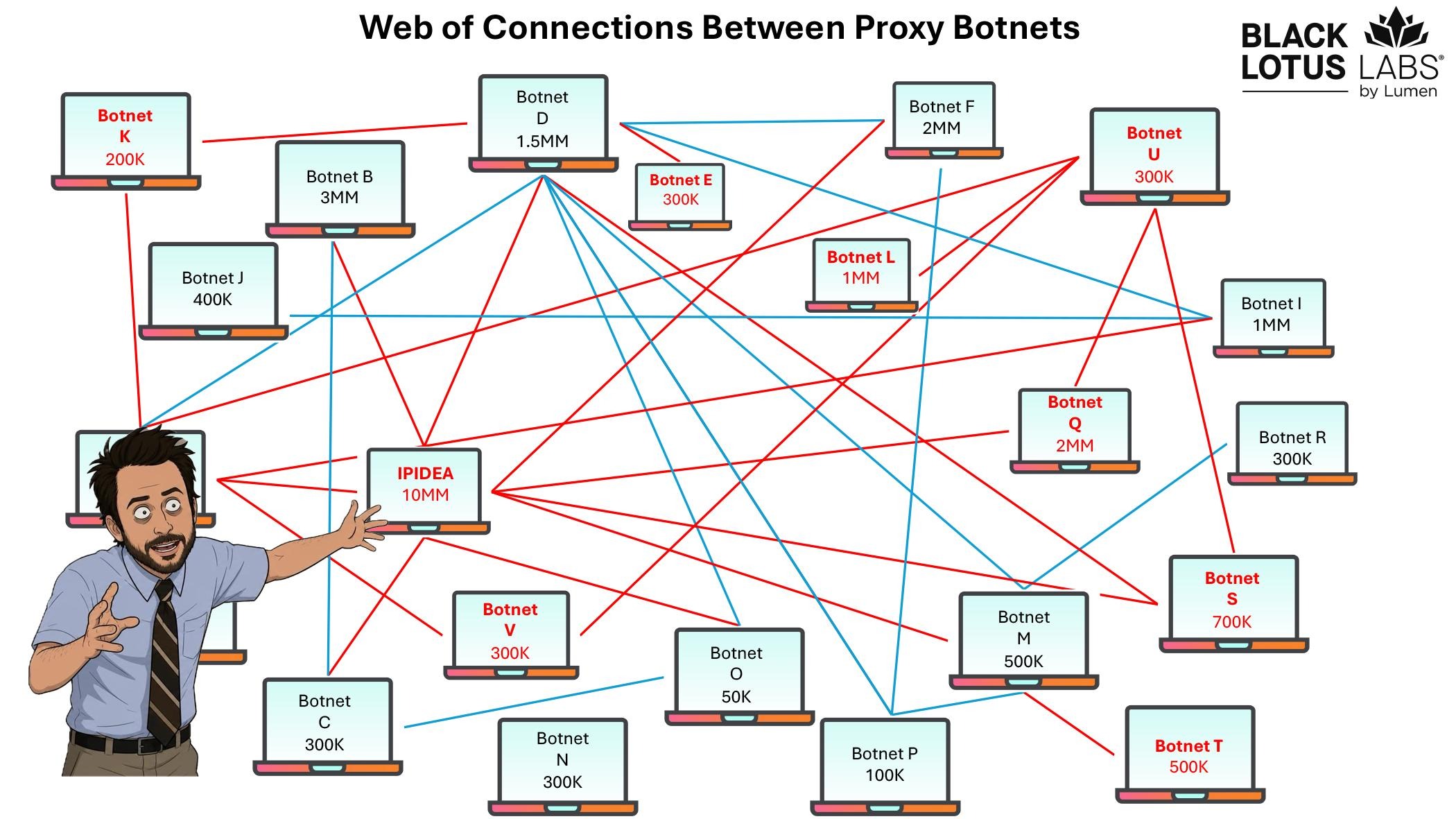
Black Lotus Labs just laid out how the residential proxy ecosystem has evolved into a full-on symbiotic parasite network — over 30 botnet clusters feeding nearly 20 million distinct IPs a day, with the big operators (IPIDEA, Jaguar, Kookeey and the rest) running millions of compromised IoT, SOHO, and mobile devices, reselling capacity to each other so the whole thing regenerates fast after any single disruption. These proxies sit inside real home and mobile traffic, which makes them nearly perfect for fraud, credential stuffing, scanning, geo-evasion, and large-scale abuse while staying under the radar. I think this is huge;
I caught the SkyTalk on it and Ryan is doing a closed-door enhanced session at RSTcon in Charlotte in October, so anyone serious about understanding the actual infrastructure under modern proxy abuse needs to be in that room.